Where things sit
A private letter ruling can answer a sharply defined federal tax question. It does not turn that answer into a rule for every taxpayer. Here is how to read the record before relying on a summary of it.
Begin with the document identity. In this example, the publisher is the Internal Revenue Service, the document is Private Letter Ruling 202627005, and the public PDF names the release date. The source link and page number let you check a quoted sentence in its original setting.
Rulings tend to follow a pattern: a statement of the facts, the law and analysis, a conclusion, and closing caveats. This one does. The analysis runs across pages 3 and 4, the conclusion is on page 4, and the statement that the ruling may not be used or cited as precedent is on page 5.
Start with the facts
A ruling responds to facts and representations supplied in a request. The conclusion in this example begins “Based solely on the facts submitted and representations made.” That opening is a constraint: changing the facts can change the usefulness of the conclusion. Read the request’s background before treating a matching phrase as a matching situation.
Read the analysis
The analysis identifies the law the IRS used. On page 4, this ruling explains that §§ 301.9100-1 through 301.9100-3 set standards for granting more time to make an election. Follow those section references to their official text when the rule itself matters. A cited section is a path to another authority, not proof that the entire Code or regulations collection is searchable in Virtus.
Sections 301.9100-1 through 301.9100-3 provide the standards the Commissioner will use to determine whether to grant an extension of time to make an election.
IRS Private Letter Ruling 202627005, page 4
Locate the conclusion
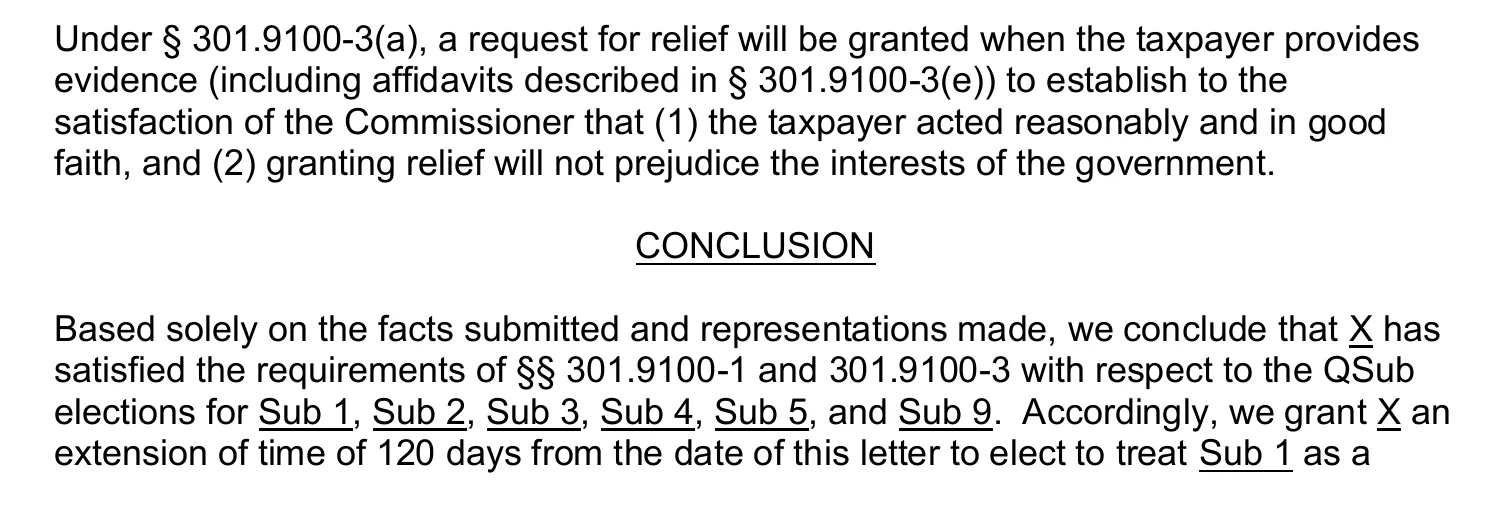
Read the conclusion against the question asked. Here the IRS concluded that the taxpayer met the requirements for an extension of time for six QSub elections. The passage above names the governing sections and the subsidiaries. A useful research note preserves that narrow result, the page where it appears, and the source document.
When an answer supplies a citation, open it. Confirm that the passage actually supports the sentence beside the marker. If a page or section cannot be resolved, the answer should not present the passage as verified support. See how a citation resolves.
Conclusion
Based solely on the facts submitted and representations made, we conclude that X has satisfied the requirements of §§ 301.9100-1 and 301.9100-3 with respect to the QSub elections for Sub 1, Sub 2, Sub 3, Sub 4, Sub 5, and Sub 9.[1]
Check its authority
The ruling states that it may not be used or cited as precedent. That status is central to its use: it shows how the IRS resolved this taxpayer’s request on the stated facts, but does not establish the outcome for another taxpayer. Keep that label attached when saving or sharing the research. What the label means is covered separately.
The collection also has a boundary. Publicly released written determinations and referenced Code or regulation sections do not amount to a complete citator, commercial commentary, or all federal tax material. Read the source coverage page before assuming a missing result means no authority exists.